
A warmer climate poses new challenges for forests and forest owners, such as what species to plant? To help answer this question, high school students are planting oak seedlings in Eastern Norway, and NIBIO’s forest scientists are investigating how they adapt.
At a logging site just north of Sarpsborg in Østfold county in South-Eastern Norway, Odin Remme-Lauten and Mio Oliver Barth-Hansen are busy planting oak trees. As students enrolled in Kalnes High School’s Natural Resources Program, their entire day is set aside for planting trees. In all, 1,200 young oak saplings are ready to be planted. Half of them are at Kalnes and the rest near Trøgstad, in the Indre Østfold municipality.
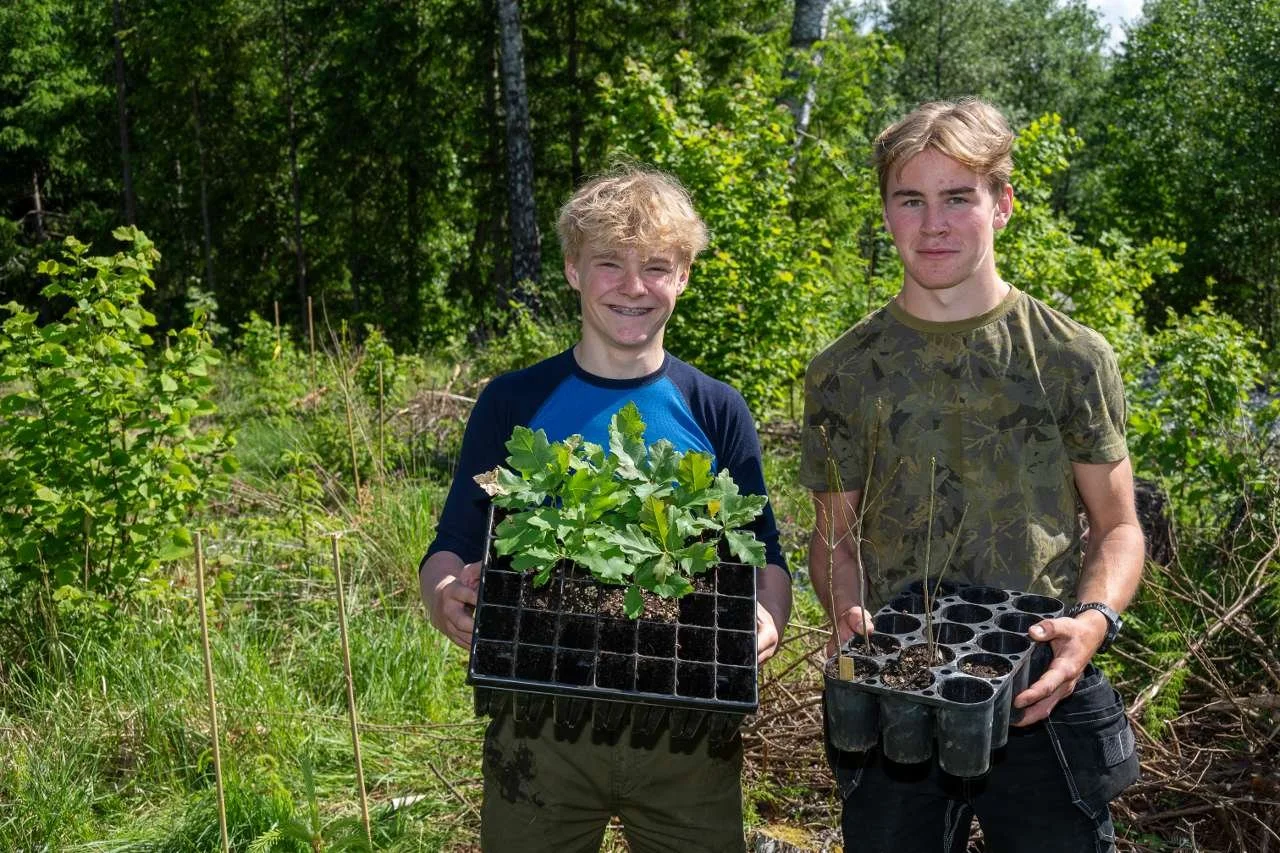
Odin Remme-Lauten and Mio Oliver Barth-Hansenplanting oak trees. Photo: Erling Fløistad, NIBIO
The work done by the busy high school students is part of a European research project, Precilience. Farmers and forest owners, researchers, and government agencies in Norway, Sweden, Denmark, Finland, and Estonia aim to develop practical solutions which can better equip agriculture and forestry to cope with climate change in Northern Europe.
One of the project’s goals is to determine how society can better create agricultural land and forests that are prepared to adapt for a warmer and drier climate. The word “Precilience” is a play on “precise” and “resilience”. The idea is that agriculture and forestry—both key land uses in Østfold county and in the rest of Norway—should be prepared to adapt to the changing climate.
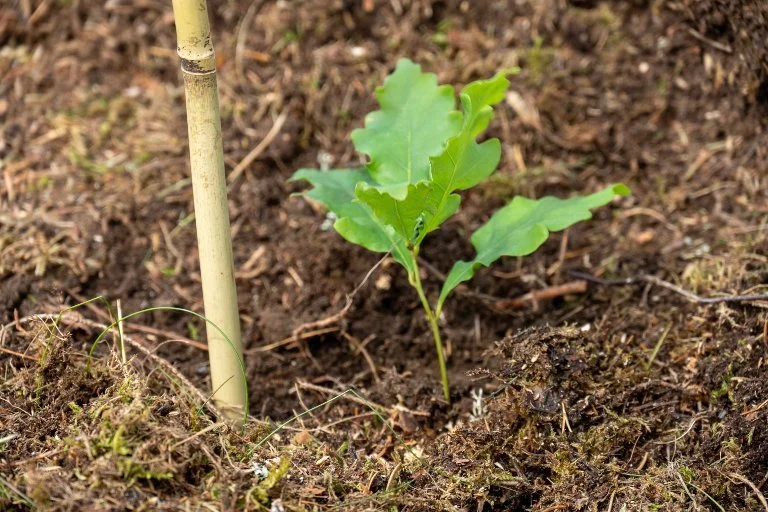
Oak seedling. Image credit: Erling Fløistad, NIBIO
Warmer and drier conditions for spruce trees
“Climate change leads to more frequent periods of drought during spring and early summer“, says Hanne Jaasund Ørmen.
Ørmen is a former high school teacher. She now works as a Senior Advisor for Østfold County Municipality.
“In addition, less snow cover and higher temperatures mean that Norway spruce trees are facing increasingly poor growing conditions in many parts of the country—including Østfold”.
Ørmen explains how prolonged drought weakens the spruce trees and makes them more vulnerable to damage and attacks from bark beetles and other pests.
Hanne Jaasund Ørmen and Østfold County Municipality are one of four Norwegian partners in the Prescilience project. The other three are NIBIO—The Norwegian Institute of Bioeconomy Research, Skogkurs—Norway’s Forestry Extension Institute, and Indre Østfold municipality.
Oak as an alternative to Norway spruce?
One of the aims of project Precilience is to investigate whether oak could be a substitute for Norway spruce in Norwegian forests in the decades to come.
NIBIO Senior Research Scientist Inger Sundheim Fløistad is an expert in forest establishment. She confirms that climate change represents a challenge to Norway’s traditional conifer-based forestry.
“Climate change is increasing the need to incorporate more tree species,” she says.
“The dry summer of 2018 clearly demonstrated how vulnerable spruce is to drought”.
Fløistad explains how oak trees have deep roots that make them more drought-tolerant than, for example, Norway spruce.
“Oak provides valuable timber. In addition, more oak saplings could have a positive effect on forest biodiversity,” Fløistad says.
Taken together, this could lead to both an increased use of oak, and oak trees playing a more important role in Norway’s future forestry.
Both forest owners and forest scientists are keen to learn more about oak trees’ possibilities.
However, there are challenges associated with oak saplings as well. Animals, such as deer, are quite fond of young oak saplings! Inger Sundheim Fløistad and her fellow forest scientists are therefore testing various methods to protect the young trees.
One method being tested is using untreated wool, wrapped around the sapling’s trunk. One half of the oak saplings planted in Sarpsborg and Trøgstad received this treatment. The hypothesis is that the scent of wool keeps the grazing animals away, thus increasing oak survival.
“Helping forest owners find the best oak seedlings to plant is important. Also, after spending many years doing experiments mostly on Norway spruce, it’s great fun being able to conduct research on oak trees,” Fløistad says.
Two wonderful days of planting oak trees!
After a long day of planting oak seedlings in the hot, blazing Østfold sun, Odin Remme-Lauten and Mio Oliver Barth-Hansen of Kalnes High School are exhausted but happy. Now, several hundred small oak trees are before them, ready to grow and become a new oak forest in perhaps a hundred years.
“It’s been two wonderful days of planting! We’re looking forward to following the oak trees’ growth and development during the coming years,” project manager Hanne Jaasund Ørmen of Østfold County Municipality says.
“The students have been a great help. I hope they found it both useful and educational to participate in a real research project”.
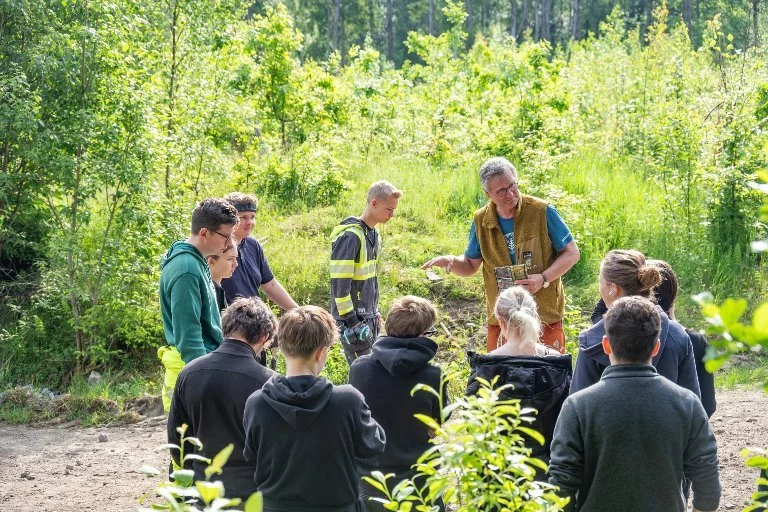
Climate change leads to more frequent drought periods during spring and early summer. Less snow cover and higher temperatures mean that Norway spruce trees face increasingly poor growing conditions in many parts of Norway. One of the questions the Precilience project is investigating is whether oak could become a more important tree species in Norwegian forests in the decades ahead. Image credit: Erling Fløistad, NIBIO
This article is adapted from an original article published by NIBIO (Norwegian Institute of Bioeconomy Research). Read the original in Norwegian here.
Sign up to our newsletter and follow our LinkedIn to stay informed on Precilience’s latest news and developments.