
Between September and November 2025, Precilience brought together more than 200 farmers, foresters, advisors, researchers, and other regional stakeholders across Finland, Sweden, Norway, Denmark, and Estonia. Across 11 regional workshops, participants worked together to identify climate risks already affecting agriculture and forestry and, crucially, to explore what adaptation looks like in practice.
Workshops addressed real problems faced by the local stakeholders: waterlogged fields that don’t drain, degrading soils, pests arriving early and staying longer, and increasing economic pressure on livelihoods.
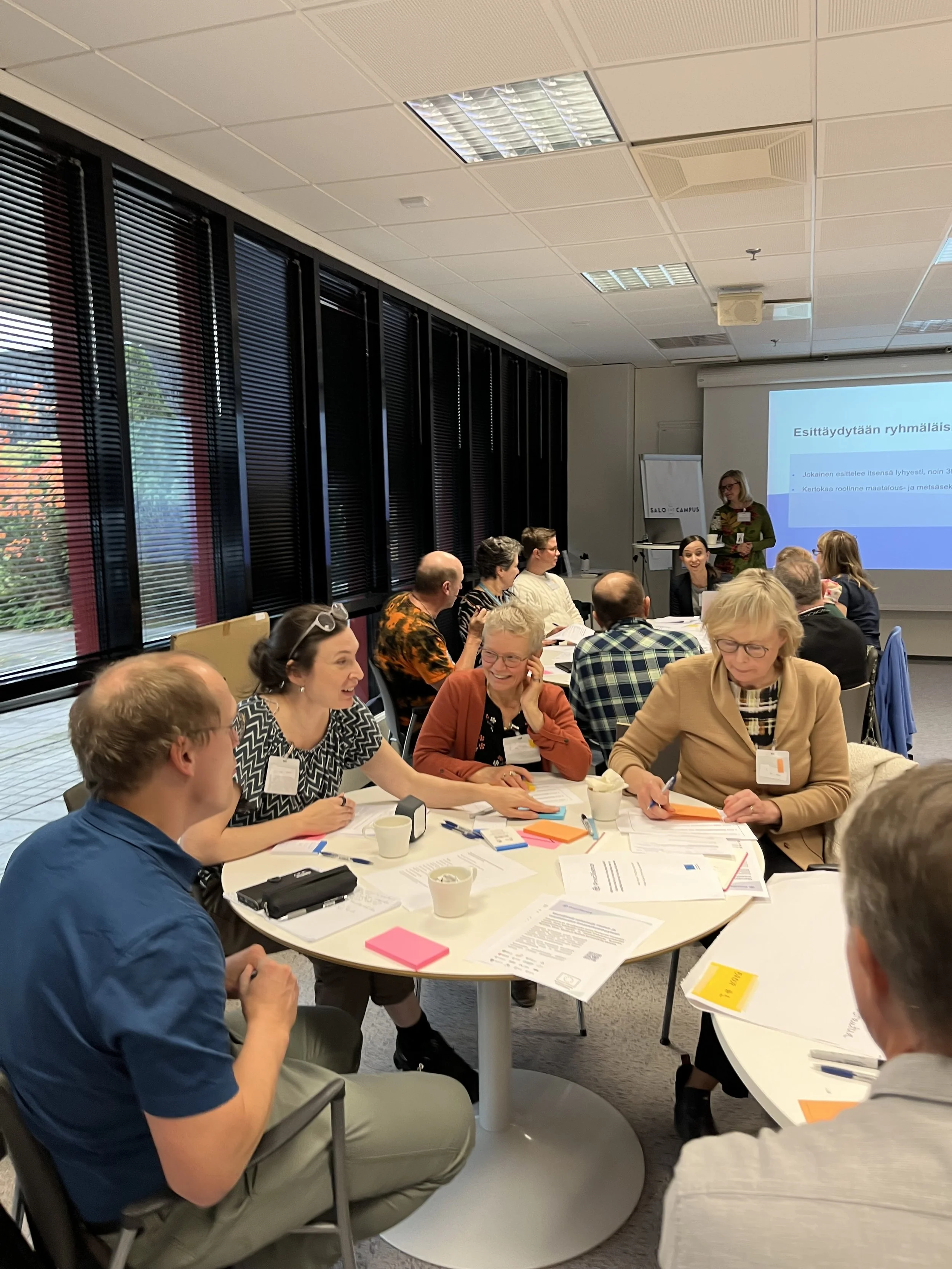
Workshop in Salo, Finland
Shared Challenges, Local Realities
Across all regions, participants raised water variation extremes as one of the most pressing risks. Droughts, heavy rainfall, flooding, and warmer, unstable winters are already disrupting both farming and forestry. Concerns about pests, diseases, and invasive species were also widespread, as were worries about profitability and long-term economic resilience.
At the same time, the workshops revealed how climate change manifests differently depending on local conditions.
In Denmark, discussions focused heavily on water management, for example, on how to cope with both drought and flooding under strict environmental regulations. In Estonia, participants highlighted ecosystem instability, with changing pest pressures creating uncertainty about the future health of forests. Norway’s challenges look different again, with persistently wet conditions making fieldwork increasingly unpredictable. In Sweden, multiple risks – drought, heavy rain, forest insects – are affecting both agriculture and forestry. In Finland, participants described a complex mixture of clay soils vulnerable to both drought and waterlogging, winters that no longer stabilise landscapes, and economic and social pressures that amplify climate impacts.
Together, these perspectives show that while climate change is a shared challenge across the Nordic-Baltic region, adaptation needs to be locally tailored.
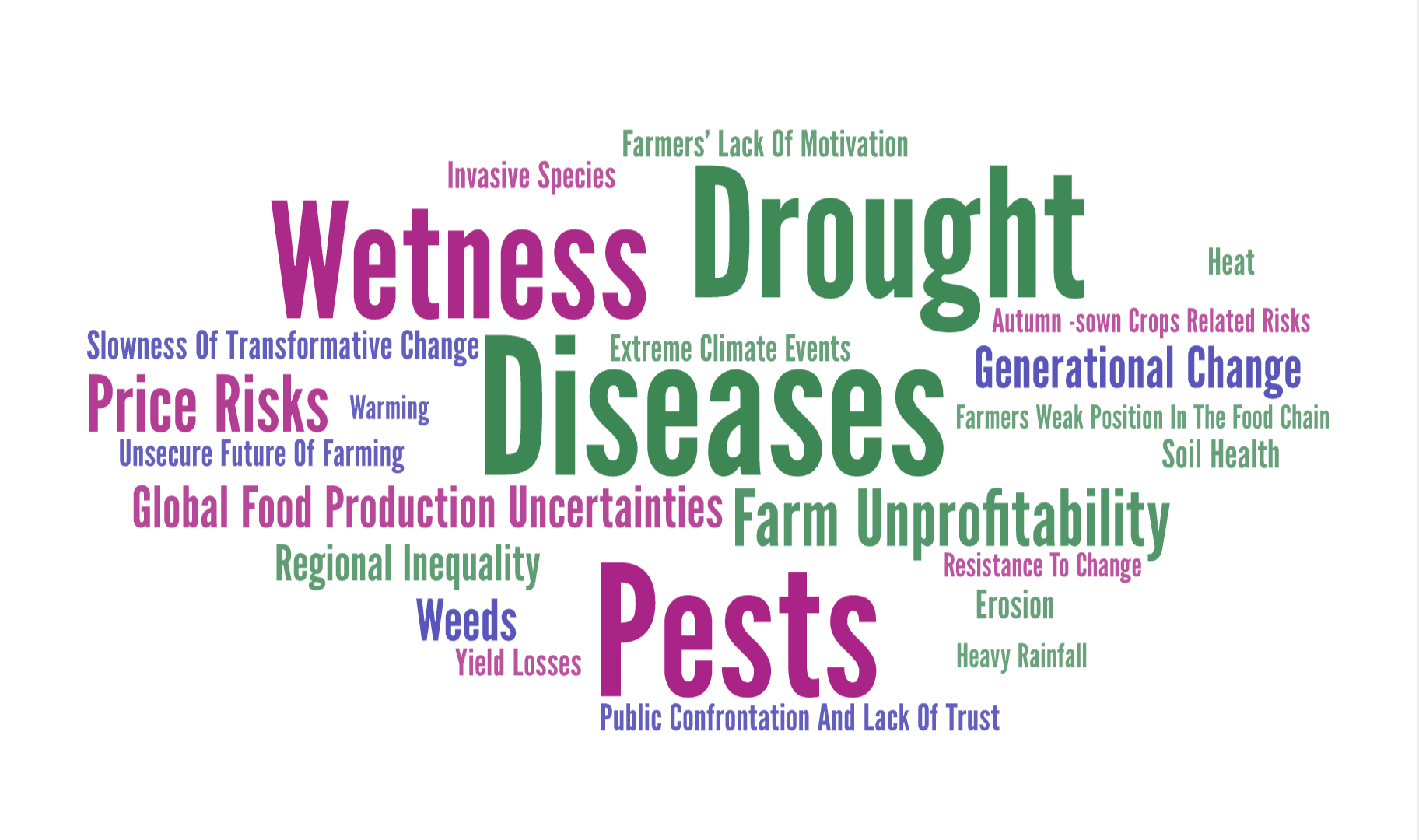
Risks for which adaptation alternatives were sought during the Finnish workshop discussions (weighted by frequency)
Adaptation is Already Happening
One clear insight from the workshops was that adaptation efforts are already in progress and solutions are being tested on farms and in forests.
When discussing agriculture, participants emphasised practical changes such as improving soil health and drainage, diversifying crop rotations, experimenting with new crops and varieties, and adjusting cultivation timing. In forestry, discussions centred on increasing resilience through species diversification, changes in harvesting regimes, better water and soil management, and improved preparedness for forest fires.
Beyond individual holdings, participants also highlighted the importance of collective and policy-level action. Education, advisory services, peer-learning, and access to reliable climate information were repeatedly identified as key enablers. Economic measures, regional planning, and market structures that reward resilience – rather than penalise experimentation – were seen as essential for adaptation at scale.

Precilience demonstration sites where adaptation solutions in agriculture and forestry are tested on the ground.
Barriers Matter as much as Solutions
The workshops clarified that identifying adaptation options is only part of the story. Financial constraints, lack of time and labour availability, gaps in knowledge, infrastructure limits, and resistance to change all act as barriers to the implementation of solutions.
Equally, participants were clear about what helps adaptation succeed: strong advisory systems, supportive policy frameworks, cooperation between actors, and social acceptance of change. These insights are shaping how Precilience approaches the assessment and demonstration of adaptation options moving forward.
Turning Dialogue into Action
The knowledge co-created during these workshops will feed directly into Precilience’s next steps: assessing adaptation options under different climate scenarios, testing solutions through local demonstrations, and developing regionally relevant tools and guidance for agriculture and forestry with stakeholders’ involvement.
By grounding scientific modelling and risk analysis in real-world experience, Precilience is working towards adaptation strategies that are not only effective in theory, but also feasible, acceptable, and useful on the ground.
A warm thank-you to everyone who contributed their time, experience, and insight. The conversations started in these workshops are a critical step towards building climate-resilient agriculture and forestry across the Nordic–Baltic region.
If you are interested in future discussions contact hello@precilience.eu.
Sign up to our newsletter and follow our LinkedIn to stay informed on Precilience’s latest news and developments.